ASTM F3299
WVTR TEST METHOD UTILIZING A P2O5 SENSOR
Equivalent to ISO 15106-3, JIS K 7129-3, GB/T 21529, DIN 53122-2
Standard Test Method for Water Vapor Transmission Rate Through Plastic Film and Sheeting Using an Electrolytic Detection Sensor (Coulometric P2O5 Sensor)
Where Used
Evaluate materials and finished packages for their barrier characteristics to water vapor. The method is used to optimize a product’s shelf-life or use-life and helps with choosing the most appropriate materials.
Description
This test method analyzes the amount of water vapor that is permeating through a flat film (such as the sidewall of a pouch) or package (either with or without a closure or lidding).
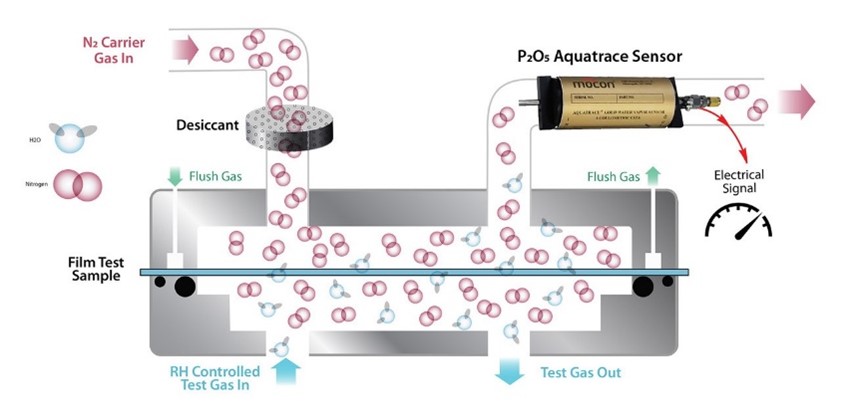
- One side of the sample is exposed to a controlled humidity level (usually 90% RH or 100% RH), while the other side of the sample is swept by a dry nitrogen carrier gas.
- The transmitting water vapor through the material or package is swept by the nitrogen gas to an electrolytic (P2O5) sensor, where the permeating water vapor is quantified.
- This water vapor level is reported as a water vapor transmission rate and expressed in terms of mg/(m2 • day).
- For more details about ASTM F3299, please visit the ASTM website.
Method Schematic and Instrumentation
Note
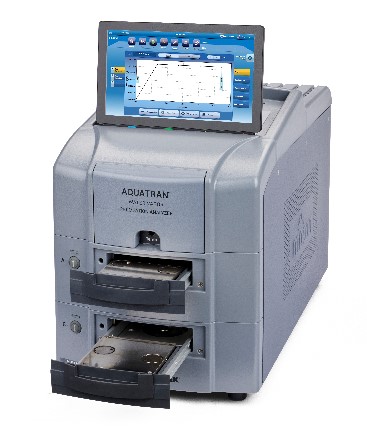
The MOCON® Aquatrace® sensor has been engineered for extremely low-level WVTR testing. With precise temperature, humidity, and flow controls, the AQUATRAN® 3 instrument is the global standard in water vapor transmission rate testing for high barrier films used with solar panel and OLED displays. For more information about the AQUATRAN 3, please visit our website. Learn more about our Lab Testing Services here.
Results
The transmission rate output is a graph of WVTR vs time (which is key to verifying equilibrium) and data report. Transmission rate test duration can range from a few hours to a few weeks, depending upon the material’s barrier characteristics and test environment. Given that most materials analyzed with this method are high barriers, it is common that a sample will test for a week or longer.
.jpg?revision=52f94981-4a4b-4b14-ac08-44eb52bc6110&h=278&w=400&la=en&hash=882E8AFD030838BB9F8E4312F153C687)
Download the ASTM F3299 Note