ASTM D3985/F1927
OXYGEN TRANSMISSION RATE (OTR) TEST METHODS
Equivalent to ISO 15105-2, JIS K7126-2, GB/T 19789 and DIN 53380-3
Standard Test Method for Oxygen Gas Transmission Rate Through Plastic Film
and Sheeting Using a Coulometric Sensor in Dry/Controlled Relative Humidity Environments
Where Used
Evaluate materials for their barrier characteristics to oxygen gas. The method is used to optimize a product’s shelf-life or use-life and helps with choosing the most appropriate materials.
Description
This test method analyzes the amount of oxygen (at steady state) that is permeating through a flat film (such as sidewall of a pouch) under dry (D3985) or humidified conditions (F1927).
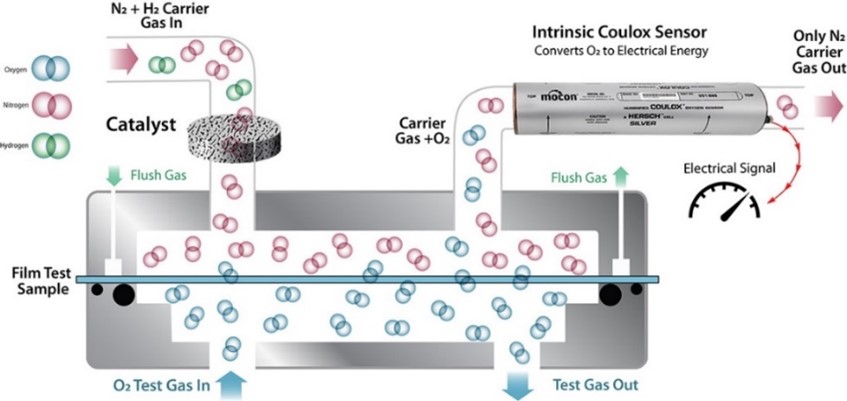
- One side of the sample is challenged by an oxygen test gas (usually 100% O2), while the other side of the sample is swept by a nitrogen carrier gas.
- Any transmitting oxygen gas through the sample is swept by the nitrogen gas to a coulometric detector, where the transmitting oxygen is measured.
- The common units for OTR are cc/(m2 • day) or cc/(100in2 • day)
- For more details on ASTM D3985 or ASTM F1927 please visit the ASTM website
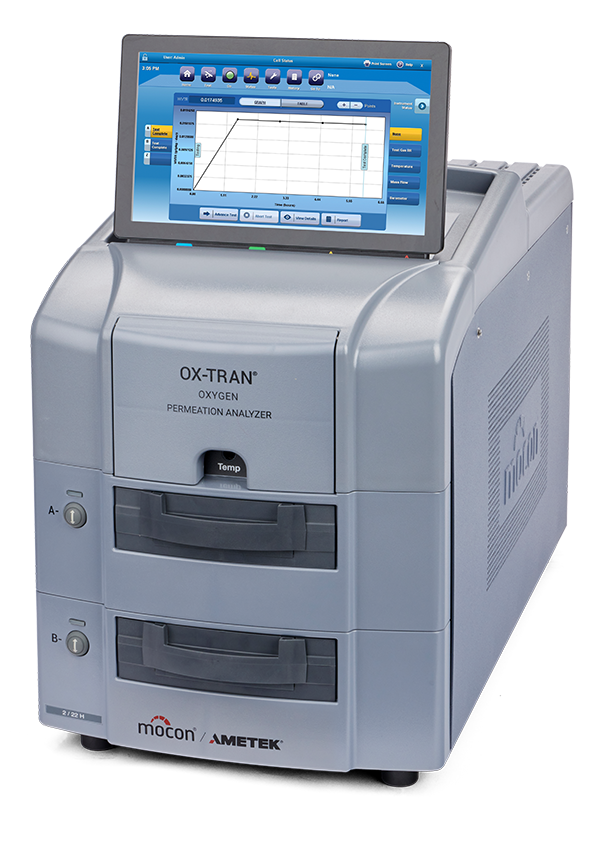
Method Schematic (for both dry and humidified film testing) and Corresponding Instrument
Note
MOCON® pioneered this test method and our patented Coulox® sensor is the most sensitive oxygen sensor for permeation testing. With our precise temperature, humidity, flow controls and calibration films, our instruments are the global standard for this test method. Learn more about AMETEK MOCON OTR Permeation Analyzers here and our Lab Testing Services here.
.
Results
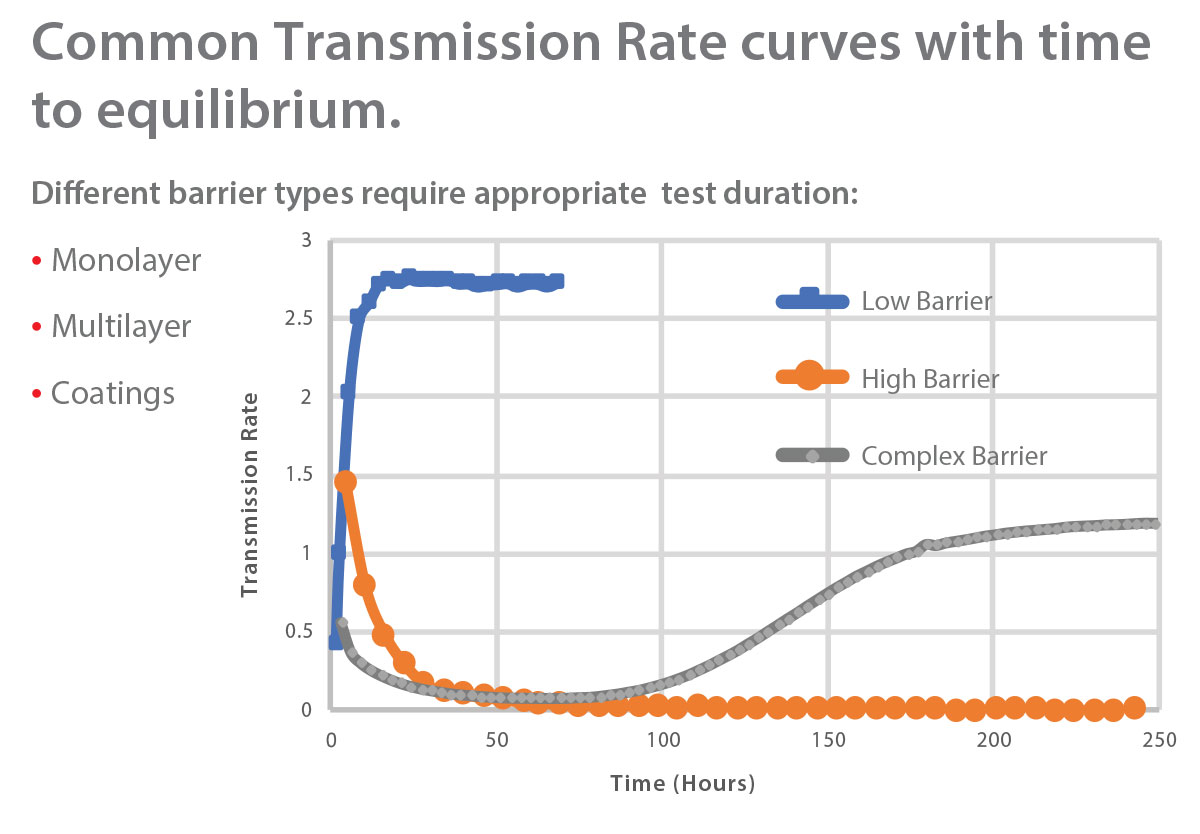
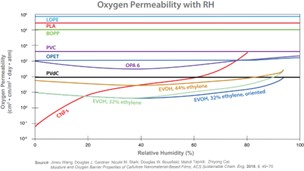
The transmission rate output is a graph of OTR vs time (which is key to verifying equilibrium) and data report. Transmission rate test duration can range from a few hours to a few weeks, depending upon the material’s barrier characteristics. High temperatures lead to higher transmission rates and faster tests, while low temperatures yield lower transmission rate values and longer test durations. Additionally, moisture sensitive samples (e.g., EVOH, Polyimides and Coated Paper) have OTRs that are impacted by humidity. Knowing your product’s need is important for optimizing the appropriate test environment.
Download the ASTM D3985/F1927 Note